> For the complete documentation index, see [llms.txt](https://dnredsons-organization.gitbook.io/p4docker/llms.txt). Markdown versions of documentation pages are available by appending `.md` to page URLs; this page is available as [Markdown](https://dnredsons-organization.gitbook.io/p4docker/overview.md).
# Overview
About the P4D
Software Defined Networking (SDN) represents a transformative approach to network architecture by decoupling the traditionally integrated control and data planes. The next step in network softwarization is data-plane programming, which involves designing and customizing the forwarding beha vior within a network device.
Programming Protocol-Independent Packet Processors (P4) have gained momentum in the networking industry, but there are several obstacles and challenges, such as introducing a new programming paradigm for networking requiring network engineers and developers to acquire a different skill set. To address this difficulty, providing an experimentation environment that bypasses the high cost of P4-enabled equipment is essential.
The P4Docker is an advanced tool designed for creating Docker-based P4 test beds. It enables users to design and implement customized networks using the P4 language and the BMv2 virtual switch implemented in a Docker Container (P4Docker). P4Docker leverages Docker containers for each network element, offering enhanced isolation, flexibility, and scalability. This environment is conducive to experimenting with programmable networks based on P4 switches, simulating intricate network topologies, and forwarding policies more accurately and efficiently.
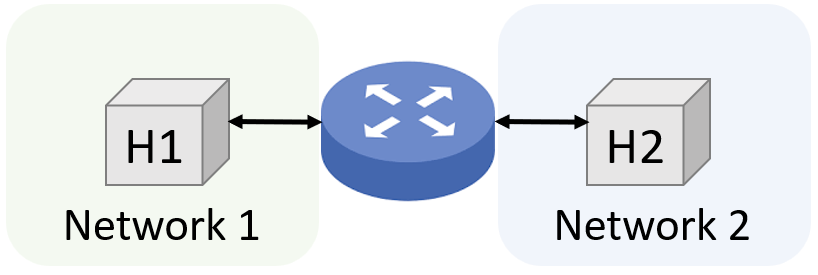
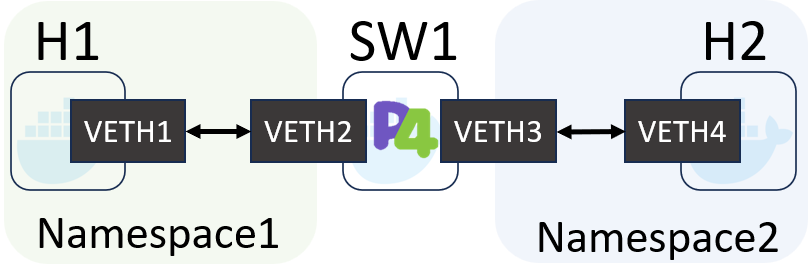
Figure 1a illustrates a traditional network, where two hosts connect through a switch to establish communication. Figure 1b is the representation of the same topology using P4D.
a) simple network topology
b) simple network topology using P4D
P4DockerI utilizes Docker containers to instantiate both hosts and switches, offering robust capabilities for managing and gleaning insights from P4 Switches. This includes sophisticated monitoring and debugging features. The framework enhances realism in network simulation by employing namespaces and Docker containers, which engage the complete TCP stack, thus emulating a comprehensive network environment. This stands in contrast to other solutions that may not provide sufficient realism or could be prohibitively costly.
Official Repository: